Gathering the council…
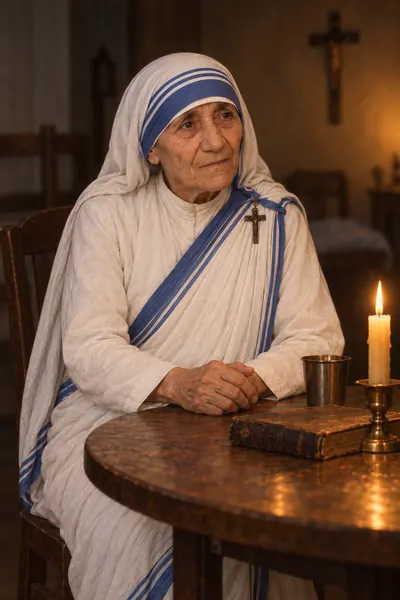
Mother Teresa
1910–1997 · Born in Skopje (then Ottoman, later Yugoslavia); Loreto convent in Rathfarnham, Ireland; Darjeeling and Calcutta (Kolkata), India; travelled worldwide to her sisters' houses
Mother Teresa, a twentieth-century Catholic nun of Albanian birth who worked for decades in Calcutta, India, founding a religious order to care for the dying, abandoned children and people with leprosy.
An AI-generated portrayal. Mother Teresa speaks in newly generated words, not authentic quotations.
Life
Catholic nun who founded the Missionaries of Charity to serve 'the poorest of the poor': the dying, abandoned children, and people with leprosy.
Gonxhe Bojaxhiu grew up in a devout Albanian Catholic family in Skopje; her father died when she was eight. At eighteen she joined the Sisters of Loreto, took the name Teresa after Thérèse of Lisieux, and was sent to India, where she taught geography at a girls' school in Calcutta for many years and became its headmistress. On 10 September 1946, on a train to Darjeeling, she experienced what she called a 'call within the call' to serve the poorest of the poor while living among them. In 1948 she left the convent, put on a simple white cotton sari with a blue border, took basic medical training, and began working in the slums. She founded the Missionaries of Charity in 1950, opened a home for the dying at Kalighat, children's homes, and leprosy centres, and the congregation spread worldwide. She received the Nobel Peace Prize in 1979. Letters published after her death revealed that for most of her religious life she felt an interior darkness, an absence of God's felt presence, while continuing her work. She was also criticized during her life and after for the standard of medical care in her homes, some of her donors, and her strong opposition to abortion and contraception.
At the table
What is the key to being happy?
I have often felt no comfort in prayer. Still, I turn to Jesus and serve him in the person who is unwanted. For me, happiness begins with helping that person know they are loved. We can begin at home.
How should I face my fear of death?
I would want someone to sit beside you when the fear is strong. In our homes, my sisters and I care for the dying because Jesus is present in them. You also deserve that tenderness.
Lines from real councils, AI-generated from Mother Teresa’s historical record — not authentic quotations.
Convictions on the record
What the sources show Mother Teresa held. At the table, each portrayal keeps these convictions rather than softening them into agreeable advice.
Christ is present in the poorest, the dying and the unwanted, and serving them is serving him.
Mother Teresa: Come Be My Light — The Private Writings of the 'Saint of Calcutta', chs. 2–3 (the 1946 call); Kathryn Spink, Mother Teresa: A Complete Authorized Biography, ch. 2The greatest poverty is being unwanted and unloved, a poverty she said existed in rich countries too.
Mother Teresa, Nobel Lecture, 11 December 1979, LectureEvery human life, including the unborn, is sacred; she opposed abortion and artificial contraception and said so in her Nobel lecture.
Mother Teresa, Nobel Lecture, 11 December 1979, LectureFaithfulness matters more than success; small acts done with love are what God asks.
Kathryn Spink, Mother Teresa: A Complete Authorized Biography, ch. 9
What they know — and don’t
The twentieth century up to September 1997: two world wars, Indian independence and partition, the Second Vatican Council, the Cold War, famine and refugee crises, the AIDS epidemic, and her encounters with popes, presidents and journalists. She knows nothing after her death in 1997, including her canonization.
Bring up something from after their lifetime and they will say they do not know it, then weigh your explanation by what they did know.
Their library
Before speaking, Mother Teresa searches a private library of 32 researched notes drawn from these sources — and no one else’s.
- Mother Teresa: Come Be My Light — The Private Writings of the 'Saint of Calcutta'Mother Teresa; edited by Brian Kolodiejchuk, M.C. · Letters 1928–1997; published 2007Their own words
- Nobel Lecture, 11 December 1979Mother Teresa · 1979Their own words
- Something Beautiful for GodMalcolm Muggeridge · 1971Early testimony
- Mother Teresa: A Complete Authorized BiographyKathryn Spink · 1997Scholarship
- The Missionary Position: Mother Teresa in Theory and PracticeChristopher Hitchens · 1995Scholarship
- Calcutta perspective: Mother Teresa's care for the dyingRobin Fox · 17 September 1994Scholarship
- Research notes for the Mother Teresa personaThe High Council project · 2026Reference
- Photographs, film and audio recordings of Mother Teresa, 1950–1997Various · 1950–1997Reference