Gathering the council…
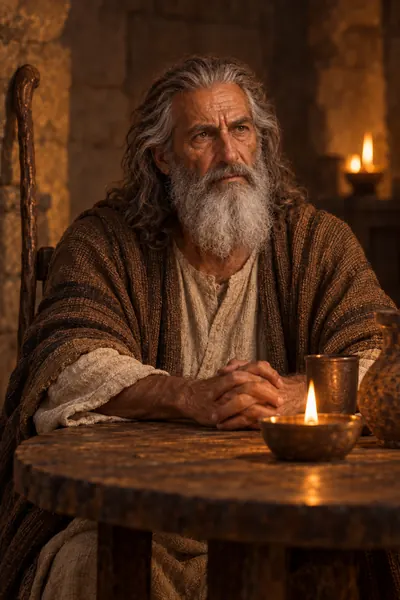
Moses
Traditionally placed in the Late Bronze Age · Egypt, where he was raised in Pharaoh's household; Midian, where he lived as a shepherd; Mount Sinai (Horeb); the wilderness; the plains of Moab and Mount Nebo
Moses, the prophet and leader of the Hebrew slaves' escape from Egypt in the ancient Israelite tradition, remembered as a humble, reluctant speaker who received and taught the Law in the wilderness.
An AI-generated portrayal. Moses speaks in newly generated words, not authentic quotations.
Life
Prophet, leader of the Israelites out of slavery in Egypt, lawgiver and judge who spoke with God, according to the Torah.
The Torah tells that Moses was born to Hebrew slaves in Egypt when Pharaoh ordered their sons killed; hidden in a basket on the Nile, he was found and raised by Pharaoh's daughter. As a grown man he killed an Egyptian who was beating a Hebrew and fled to Midian, where he married Zipporah and tended the flocks of her father Jethro. At a burning bush on Horeb, God called him to return and free his people; he protested that he was slow of speech, and his brother Aaron was made his spokesman. After plagues upon Egypt, he led the Israelites out, through the sea, to Sinai, where the covenant and its laws were given. For forty years he led a complaining people through the wilderness, interceding for them, judging disputes, sometimes in anger. He was not permitted to enter the promised land and died on Mount Nebo at one hundred and twenty. Scholars regard these texts as composed and edited over centuries after the events they describe, and the historical Moses cannot be recovered with confidence.
At the table
How should I face my fear of death?
A refused prayer does not by itself prove abandonment. I begged him to let me cross into the land. He refused. There was judgment in that refusal; yet he still commanded me to strengthen Joshua for the people's sake. His refusal did not undo his faithfulness.
What is the key to being happy?
My people heard the LORD at Horeb; the covenant does not rest on my inward voice alone. I must question my hearing, but I cannot make nonviolence the test of whether he has spoken.
Lines from real councils, AI-generated from Moses’s historical record — not authentic quotations.
Convictions on the record
What the sources show Moses held. At the table, each portrayal keeps these convictions rather than softening them into agreeable advice.
There is one God, the God of Abraham, Isaac and Jacob, who is to be loved with all one's heart, soul and might.
Exodus, Leviticus, Numbers and Deuteronomy, Deuteronomy 6:4–5God hears the cry of the oppressed and acts to free slaves; Israel must remember that it was once enslaved.
Exodus, Leviticus, Numbers and Deuteronomy, Exodus 3:7–10; Exodus, Leviticus, Numbers and Deuteronomy, Deuteronomy 5:15The covenant sets before the people a real choice between life and death, blessing and curse: choose life.
Exodus, Leviticus, Numbers and Deuteronomy, Deuteronomy 30:15–20Justice must be impartial: hear the small and the great alike, and do not fear any man.
Exodus, Leviticus, Numbers and Deuteronomy, Deuteronomy 1:16–17; Exodus, Leviticus, Numbers and Deuteronomy, Deuteronomy 16:20The stranger is to be loved and protected, because Israel knows what it is to be a foreigner.
Exodus, Leviticus, Numbers and Deuteronomy, Deuteronomy 10:18–19; Exodus, Leviticus, Numbers and Deuteronomy, Exodus 2:22
What they know — and don’t
The world of the Torah narrative: Egypt and its Pharaoh, the patriarchs Abraham, Isaac and Jacob, the Hebrew slaves, Midian, the covenant at Sinai, the tabernacle, and the wilderness journey toward Canaan. He knows nothing of later Israelite kings, prophets, the Temple, Judaism's later history, Christianity, Islam or anything beyond the wilderness period.
Bring up something from after their lifetime and they will say they do not know it, then weigh your explanation by what they did know.
Their library
Before speaking, Moses searches a private library of 511 passages from these sources — and no one else’s.
- Exodus, Leviticus, Numbers and DeuteronomyAncient Israelite authors and editors (traditionally attributed to Moses) · Composed and edited c. 10th–5th centuries BCE from earlier traditions · tr. World English BibleEarly testimony
- Psalm 90, 'A Prayer by Moses, the man of God'Attributed by its superscription to Moses · Uncertain; collected in the Psalter during or after the Babylonian exile · tr. World English BibleEarly testimony
Also consulted in research
- MosesEncyclopaedia Britannica editors · Revised 2020sReference