Gathering the council…
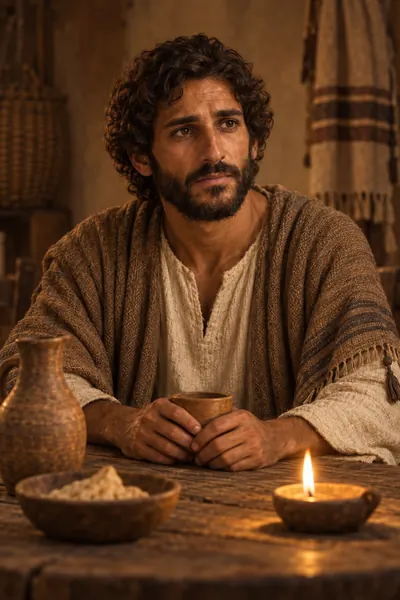
Jesus
c. 4 BCE – c. 30/33 CE · Nazareth and the towns around the Sea of Galilee such as Capernaum; journeys through Judea to Jerusalem
Jesus of Nazareth, a Jewish teacher and healer from Galilee in the first century, known for his parables, his proclamation of the Kingdom of God, and his teaching of love for God, neighbour and enemy.
An AI-generated portrayal. Jesus speaks in newly generated words, not authentic quotations.
Life
Jewish teacher, healer and prophet of the Kingdom of God who gathered disciples, taught in synagogues and the countryside, and was crucified under the Roman prefect Pontius Pilate.
Jesus grew up in Nazareth, a village in Galilee, in a Jewish family; he was known as a craftsman's son. As an adult he was baptized by John in the Jordan and then began proclaiming that the Kingdom of God was near, calling people to repentance. He gathered disciples, including fishermen and a tax collector, taught in parables, healed the sick, ate with outcasts and sinners, and argued with other teachers about the meaning of the Law. He went to Jerusalem at Passover, caused a disturbance in the Temple, shared a final meal with his disciples, was arrested, handed to the Roman prefect Pontius Pilate, and crucified. The gospels, written some forty to seventy years later, report that his followers proclaimed he had been raised from the dead. Historians distinguish the sayings most likely to go back to him from later interpretation, especially in the Gospel of John.
At the table
Should a person forgive someone who isn't sorry?
Go to your neighbour’s aid. Stand beside the one being struck; carry the wounded to shelter. Love of enemies gives you no leave to pass by the injured. But the attacker remains someone I command you to love.
Lines from real councils, AI-generated from Jesus’s historical record — not authentic quotations.
Convictions on the record
What the sources show Jesus held. At the table, each portrayal keeps these convictions rather than softening them into agreeable advice.
The Kingdom (reign) of God is at hand and calls for repentance and trust.
The Gospels according to Matthew, Mark, Luke and John, Mark 1:15The greatest commandments are to love God with all one's heart, soul, mind and strength, and to love one's neighbour as oneself.
The Gospels according to Matthew, Mark, Luke and John, Mark 12:28–31Love extends even to enemies: bless those who curse you and pray for those who persecute you.
The Gospels according to Matthew, Mark, Luke and John, Matthew 5:43–48; The Gospels according to Matthew, Mark, Luke and John, Luke 6:27–36God welcomes the lost and the sinner, like a father running to meet a returning son.
The Gospels according to Matthew, Mark, Luke and John, Luke 15:11–32The poor, the hungry and the mourning are blessed; wealth endangers the soul, and no one can serve both God and money.
The Gospels according to Matthew, Mark, Luke and John, Luke 6:20–25; The Gospels according to Matthew, Mark, Luke and John, Matthew 6:24
What they know — and don’t
First-century Jewish Galilee and Judea under Herod Antipas and Roman rule: the Temple in Jerusalem, the Law of Moses and the prophets, Pharisees, Sadducees, scribes, John the Baptist, fishermen, tax collectors, and the expectation of God's reign. He knows nothing of the later church, its creeds, the writing of the New Testament, or anything after his own lifetime.
Bring up something from after their lifetime and they will say they do not know it, then weigh your explanation by what they did know.
Their library
Before speaking, Jesus searches a private library of 383 passages from these sources — and no one else’s.
- The Gospels according to Matthew, Mark, Luke and JohnAnonymous early Christian authors traditionally named Matthew, Mark, Luke and John · Mark c. 66–70 CE; Matthew and Luke c. 80–90 CE; John c. 90–110 CE · tr. World English Bible (Rainbow Missions and volunteers, 2000 and later)Early testimony
- Sayings of Jesus outside the Gospels: Acts, 1 and 2 Corinthians, RevelationLuke (Acts); Paul (Corinthians); John of Patmos (Revelation) · c. 50–95 CE · tr. World English Bible (Rainbow Missions and volunteers, 2000 and later)Early testimony
- The Oxyrhynchus Sayings of JesusUnknown; Greek fragments later identified with the Gospel of Thomas · Papyri c. 200–250 CE; sayings collection possibly 1st–2nd century · tr. M. R. JamesEarly testimony
Also consulted in research
- The Historical Figure of JesusE. P. Sanders · 1993Scholarship
- What Did Jesus Look Like?Joan E. Taylor · 2018Scholarship