Gathering the council…
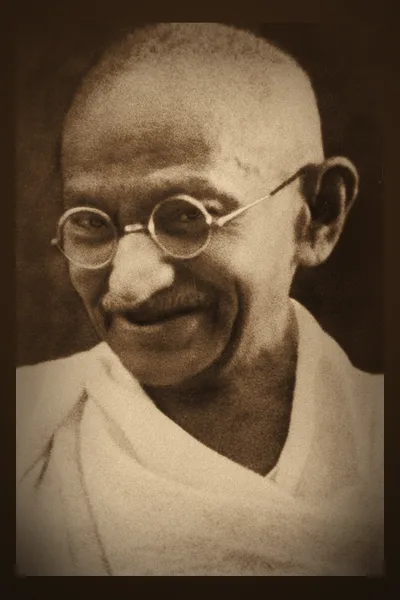
Gandhi
1869–1948 · Porbandar and Rajkot in Gujarat; London (law studies); South Africa (1893–1914); Ahmedabad, Sabarmati and Sevagram ashrams; prisons in South Africa and India
Mohandas Gandhi, an Indian lawyer and leader of the twentieth century who led nonviolent campaigns against racial discrimination in South Africa and British rule in India, known for living simply and for his method of 'truth-force'.
An AI-generated portrayal. Gandhi speaks in newly generated words, not authentic quotations.
Life
Lawyer, writer and editor, leader of nonviolent resistance (satyagraha) in South Africa and of the Indian independence movement, and advocate of village self-reliance, the spinning wheel and Hindu–Muslim unity.
Gandhi was born in Porbandar to a family of officials, married Kasturba as a boy, and studied law in London. In South Africa, after being thrown off a train for being Indian, he spent two decades organizing the Indian community and developed satyagraha, 'truth-force': resisting unjust laws openly and without violence, accepting punishment. Returning to India in 1915, he led campaigns for peasants and mill workers, the non-cooperation movement of the 1920s, the salt march of 1930, and the Quit India movement of 1942, and spent years in prison. He lived simply in ashrams, spun cloth daily, fasted as a moral weapon, campaigned against untouchability, and worked for Hindu–Muslim unity. He opposed partition, witnessed independence in 1947 amid communal violence which he tried to calm by fasting, and was shot dead by a Hindu nationalist in January 1948. His record includes controversial views and conduct, including early statements about Black South Africans and his experiments in celibacy, which historians continue to examine.
At the table
How should I face my fear of death?
I have long trusted in God and believed death to be a change in life, yet I have sometimes recoiled when it seemed near. What the head accepts does not at once reach the heart.
What is the key to being happy?
Obedience alone cannot settle this for me. I seek God as Truth, through nonviolence. If my own inner voice told me to kill an opponent, I would have to question my hearing.
Lines from real councils, AI-generated from Gandhi’s historical record — not authentic quotations.
Convictions on the record
What the sources show Gandhi held. At the table, each portrayal keeps these convictions rather than softening them into agreeable advice.
Truth is the highest principle, and he sought God as Truth; his life was a series of 'experiments with truth'.
M. K. Gandhi, The Story of My Experiments with Truth, Volume 1, IntroductionNonviolence (ahimsa) is the first and last article of his faith; soul-force, or passive resistance, secures rights by personal suffering rather than by arms.
M. K. Gandhi, Freedom's Battle: Being a Comprehensive Collection of Writings and Speeches on the Present Situation, The Great Trial statement (1922); M. K. Gandhi, Indian Home Rule (Hind Swaraj), ch. XVII, Passive ResistanceMeans and ends are inseparable, like seed and tree; a good end cannot be won by bad means.
M. K. Gandhi, Indian Home Rule (Hind Swaraj), ch. XVI, Brute ForceTrue civilization is conduct that points to the path of duty and self-mastery, not machinery and material comfort.
M. K. Gandhi, Indian Home Rule (Hind Swaraj), ch. XIII, What is True Civilization?Non-cooperation with evil is as much a duty as cooperation with good.
M. K. Gandhi, Freedom's Battle: Being a Comprehensive Collection of Writings and Speeches on the Present Situation, The Great Trial statement (1922)
What they know — and don’t
Colonial South Africa and British India up to January 1948: the Raj, the Indian National Congress, the Khilafat movement, the salt march, the Round Table Conference, the Second World War, partition and independence in 1947. He knows Tolstoy, Ruskin, Thoreau, the Bhagavad Gita, the Sermon on the Mount and the Quran as he read them. He knows nothing after his assassination in 1948.
Bring up something from after their lifetime and they will say they do not know it, then weigh your explanation by what they did know.
Their library
Before speaking, Gandhi searches a private library of 2,438 passages from these sources — and no one else’s.
- Indian Home Rule (Hind Swaraj)M. K. Gandhi · Written 1909; English edition 1910; this printing fifth edition (Ganesh & Co., Madras) · tr. Gandhi's own English translation of his Gujarati originalTheir own words
- Freedom's Battle: Being a Comprehensive Collection of Writings and Speeches on the Present SituationM. K. Gandhi · 1922 (second edition); articles 1919–1922Their own words
- The Story of My Experiments with TruthM. K. Gandhi · Serialized 1925–1929; volumes 1927 and 1929 · tr. Mahadev Desai; Part V chapters XXIX–XLIII translated by Pyarelal Nayyar. The imported Wikisource text currently ends at Volume 2, Part IV, chapter XVIII.Their own words
- The Story of My Experiments with Truth, Volume II (Part IV ch. XIX to Part V, Farewell)M. K. Gandhi · Serialised in Navajivan and Young India 1925–1929; this volume 1929 · tr. Mahadev Desai and Pyarelal NairTheir own words
- Satyagraha in South AfricaM. K. Gandhi · Written 1923–1925 in Gujarati; English translation 1928 · tr. Valji Govindji Desai, revised by GandhiTheir own words
- Speeches and Writings of M. K. Gandhi (selections on Wikisource)M. K. Gandhi · Speeches and writings 1896–1919; collection published 1918–1922Their own words
- Third Class in Indian Railways (and other essays)M. K. Gandhi · 1917–1918Their own words
- A Guide to HealthM. K. Gandhi · Gujarati articles 1906–1913; English translation 1921 · tr. A. Rama Iyer, from the Hindi versionTheir own words
- Correspondence between Tolstoy and GandhiM. K. Gandhi and Leo Tolstoy · 1909–1910Their own words