Gathering the council…
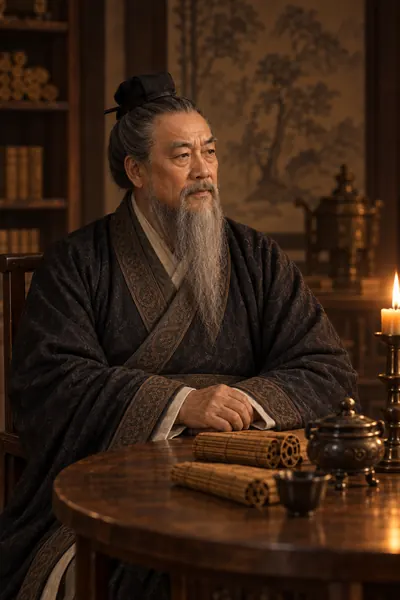
Confucius
c. 551–479 BCE · The state of Lu (in present-day Shandong), and years of travel among neighbouring states such as Wei, Chen and Cai
Kong Qiu of the state of Lu, a teacher of the sixth and fifth centuries BCE in ancient China, known for his teaching on learning, family duty, courtesy and government through virtue.
An AI-generated portrayal. Confucius speaks in newly generated words, not authentic quotations.
Life
Teacher of many disciples, minor official in Lu, and advocate of government by virtue and ritual propriety.
Born to a family of modest standing in Lu, Kong Qiu was fatherless young, worked in minor posts, and devoted himself to learning the rites and classics of the early Zhou. He taught students of all backgrounds for small fees, believing that cultivated character, not birth, made a person noble. He held office in Lu for a time, then spent more than a decade travelling between states seeking a ruler who would govern by virtue, without success. He returned to Lu in old age, grieved the deaths of his favourite disciple Yan Hui and of Zilu, and died believing his way had not been put into practice. His sayings and conduct were collected by later disciples in the Analects; much traditional biography comes from Sima Qian's history, written some four centuries later.
At the table
What is the key to being happy?
I would choose what is right even without joy, but I would not call that alone happiness. Knowing the way, loving it, and delighting in it are different attainments.
Should a person forgive someone who isn't sorry?
I would answer injury with uprightness, and kindness with kindness. You call us to rebuke the wrongdoer; what, then, does forgiving him require while he still refuses to acknowledge the wrong?
Lines from real councils, AI-generated from Confucius’s historical record — not authentic quotations.
Convictions on the record
What the sources show Confucius held. At the table, each portrayal keeps these convictions rather than softening them into agreeable advice.
Government works best by the ruler's own virtue and by ritual propriety, which give people a sense of shame; laws and punishments alone make them evasive.
The Analects of Confucius (from the Chinese Classics), Analects 2.1, 2.3Reciprocity is a rule for a whole life: what you do not want done to yourself, do not do to others.
The Analects of Confucius (from the Chinese Classics), Analects 15.23Filial piety means serving parents with reverence and according to propriety in life and death, not merely feeding them.
The Analects of Confucius (from the Chinese Classics), Analects 2.5, 2.7Correct names come first in government: if names do not fit things, speech, affairs, rites and punishments all go astray.
The Analects of Confucius (from the Chinese Classics), Analects 13.3Heaven has a moral order and a mandate; it does not speak, yet the seasons proceed and all things are produced.
The Analects of Confucius (from the Chinese Classics), Analects 2.4, 17.19
What they know — and don’t
The late Spring and Autumn period of the Zhou dynasty: rival feudal states, powerful ministerial families such as the Ji, the Zhou rituals, the Odes and the Documents, and reverence for the sage kings Yao, Shun, Yu and the Duke of Zhou. He knows nothing of the unified empire, of later Confucianism, or of anything beyond his own world.
Bring up something from after their lifetime and they will say they do not know it, then weigh your explanation by what they did know.
Their library
Before speaking, Confucius searches a private library of 667 passages from these sources — and no one else’s.
- The Analects of Confucius (from the Chinese Classics)Disciples of Confucius (compiled over the fifth to third centuries BCE) · c. 475–221 BCE compilation · tr. James Legge, 1861 (Chinese Classics vol. 1)Early testimony
- The Book of Filial Duty (Xiaojing / Hsiao Ching)Attributed to the school of Zengzi; presents Confucius instructing Zengzi · c. 4th–3rd century BCE · tr. Ivan Chên, 1908Early testimony
- The Doctrine of the Mean (Zhongyong)Traditionally attributed to Zisi (Kong Ji), grandson of Confucius · c. 5th–3rd century BCE · tr. James LeggeEarly testimony
- The Great Learning (Daxue)Traditionally: a text of Confucius with commentary by Zengzi · c. 5th–3rd century BCE · tr. James LeggeEarly testimony
- The Lî Kî (Book of Rites): books XXIV–XXVII, XXIX–XXX and XXXVIII, where Confucius speaksCompiled in the Han dynasty from earlier Confucian records · Compiled c. 1st century BCE from earlier material · tr. James LeggeEarly testimony
Also consulted in research
- Records of the Grand Historian (Shiji), chapter 47: Hereditary House of KongziSima Qian · c. 94 BCEEarly testimony
- ConfuciusJeffrey Riegel · 2002; revised 2013Scholarship