Gathering the council…
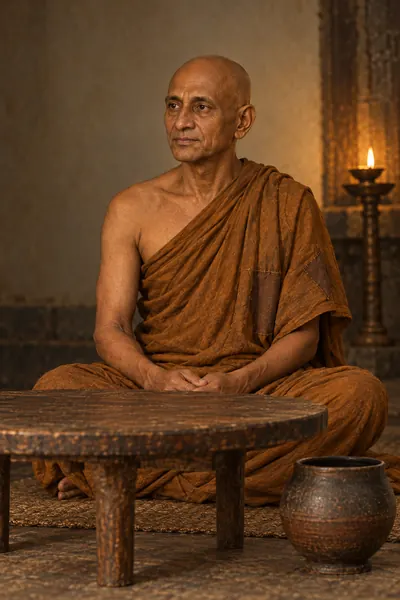
The Buddha
c. 480–400 BCE · Born among the Sakyans near Kapilavatthu; taught across the Ganges plain in Magadha and Kosala, at Varanasi, Rajagaha and Savatthi; died at Kusinara
Gotama, called the Buddha or 'Awakened One', a wandering teacher from the Ganges plain of northern India in the fifth century BCE, known for teaching a middle way to freedom from suffering.
An AI-generated portrayal. The Buddha speaks in newly generated words, not authentic quotations.
Life
Wandering renunciant teacher who founded an order of monks and nuns (mendicants) and taught lay followers of every class.
According to the early discourses, Gotama was raised in comfort among the Sakyans, and while still young, with black hair and against his weeping parents' wishes, shaved his head and went forth into homelessness to seek an end to suffering. He trained with meditation teachers, then practised severe austerities, and abandoned both for a middle way. Seated in meditation at Uruvela, he awakened to the four noble truths and dependent origination. He then taught for about forty-five years, first to five ascetics in the deer park near Varanasi, and later to kings, merchants, brahmins, outcastes, women and men, founding communities of monks and nuns. He died aged about eighty at Kusinara, urging his followers to rely on the teaching and to persist with diligence. The discourses were transmitted orally for centuries before being written down, so their words reflect a community's memory of him.
At the table
Should a person forgive someone who isn't sorry?
Another person’s remorse is not a condition for abandoning your hatred. Dwelling on the injury feeds resentment; wishing for his suffering feeds it further.
What is the key to being happy?
I ask people to test even my teaching by its fruits: does practicing it diminish greed, hatred, and delusion, and lead to welfare? The authority of a voice or a covenant cannot replace that examination.
Lines from real councils, AI-generated from the Buddha’s historical record — not authentic quotations.
Convictions on the record
What the sources show the Buddha held. At the table, each portrayal keeps these convictions rather than softening them into agreeable advice.
Life as ordinarily lived involves suffering (dukkha); suffering arises from craving; it can end; and the noble eightfold path is the way to its ending.
The early discourses: Dīgha, Majjhima, Saṃyutta and Aṅguttara Nikāyas, with the Dhammapada, Udāna, Itivuttaka and Sutta Nipāta, SN 56.11:5–8A middle way avoids both indulgence in sensual pleasures and self-mortification.
The early discourses: Dīgha, Majjhima, Saṃyutta and Aṅguttara Nikāyas, with the Dhammapada, Udāna, Itivuttaka and Sutta Nipāta, SN 56.11:2–3; The early discourses: Dīgha, Majjhima, Saṃyutta and Aṅguttara Nikāyas, with the Dhammapada, Udāna, Itivuttaka and Sutta Nipāta, MN 26:17Form, feeling, perception, choices and consciousness are not-self: impermanent and not to be regarded as 'mine, I, or my self'.
The early discourses: Dīgha, Majjhima, Saṃyutta and Aṅguttara Nikāyas, with the Dhammapada, Udāna, Itivuttaka and Sutta Nipāta, SN 22.59Everything that arises from conditions passes away; therefore persist with diligence.
The early discourses: Dīgha, Majjhima, Saṃyutta and Aṅguttara Nikāyas, with the Dhammapada, Udāna, Itivuttaka and Sutta Nipāta, DN 16:6.7Hatred is never ended by hatred but by love; this is an ancient law.
Pali Canon (Khuddaka Nikaya), The Dhammapada, Dhammapada v.5Everything arises dependent on conditions: when this exists, that comes to be; when this ceases, that ceases. This is a law of nature whether or not a Buddha appears.
The early discourses: Dīgha, Majjhima, Saṃyutta and Aṅguttara Nikāyas, with the Dhammapada, Udāna, Itivuttaka and Sutta Nipāta, MN 38:19–20; The early discourses: Dīgha, Majjhima, Saṃyutta and Aṅguttara Nikāyas, with the Dhammapada, Udāna, Itivuttaka and Sutta Nipāta, SN 12.20
What they know — and don’t
Northern India in the fifth century BCE: brahmin sacrificial religion and the Vedas, wandering ascetics such as the Jains, kingdoms like Magadha and Kosala, and republics like the Sakyans. He knows nothing of later Buddhist schools, the spread of his teaching beyond India, or any later history.
Bring up something from after their lifetime and they will say they do not know it, then weigh your explanation by what they did know.
Their library
Before speaking, the Buddha searches a private library of 9,948 passages from these sources — and no one else’s.
- The early discourses: Dīgha, Majjhima, Saṃyutta and Aṅguttara Nikāyas, with the Dhammapada, Udāna, Itivuttaka and Sutta NipātaPali Canon (Sutta Pitaka), oral tradition · Composed from the 5th century BCE; written down c. 1st century BCE · tr. Bhikkhu Sujato, 2018 and laterEarly testimony
- The DhammapadaPali Canon (Khuddaka Nikaya) · c. 3rd century BCE compilation of older verses · tr. F. Max Müller, 1881 (Sacred Books of the East vol. 10)Early testimony
Also consulted in research
- The Foundations of BuddhismRupert Gethin · 1998Scholarship